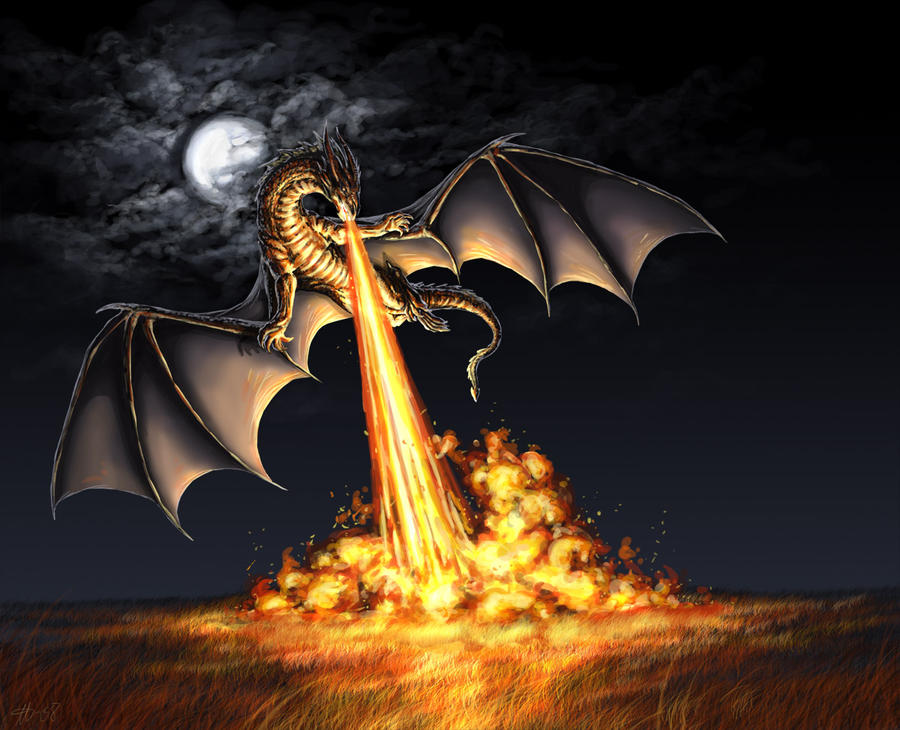
Have you ever been to a circuit to see magician breathing fire? Or at least saw those tricks on TV? Dragon or perhaps any kind of creature might have possess the ability to breathe fire with the same mechanism as magicians, except dragon didn't need external fuel for its trick. Just look at human body for instant, we can involuntarily produce methane (CH4), a highly flammable gas, through our digestive systems. Why not dragon? Ever saw AFV (American funniest video)? There was a fat man farted into a small flame, and got his gas ignited burning his friend. With fire-breathing ability, dragon could have use them for hunting, defending, or even warming. So there was a high chance that dragon might evolve just to do that. All dragon needed was a spark to ignite methane gas or any flammable gas they possibly produced. A biologist, may argue that how can animal make fire while ancient humans discovered fire not so long ago? As I previously stated, all dragon needed was a spark, it could be an electrical spark! Again, physicists may disapprove even more strongly than biologists because Maxwell united the electric force and magnetic force just more than a century ago, and the existence or use of electricity didn't reach its technological momentum until 20th century. Have you ever heard of electric eels? Yeah. That's the answer! Some animals can produce electricity by themselves. Several years ago, I had the opportunity to see Christmas lights flashing different colors by the electrical energy produced by electric eel on TV. It was an idea originated from Japan, but I didn't have chance to do more research on this. So, what's the point? As we see, nature/animal can produce methane and electricity. The right combination of this two conditions with certainly create a fire breathing creature which we call dragon. Why dragon didn't get kill by its hot fire? The fire didn't come from the stomach of the dragon or any where inside its body, but the fuel which was methane was breathed out through the dragon's front doors (which was opposite to the fat man in AFV using his backdoor). Therefore, it's reasonable to deduce that the electric spark was ignited at the every end of these methane doors.
What's about the other things? Like flying, and poisonous part of dragon?
Flying can be seen in animals, birds for instance, but it doesn't stop there. The history of celestial monsters dates back to hundreds millions years ago, when dinosaurs still rampant the earth. Dragons might have been flying side by side with Pterosaurs and even hunting these poor dinosaurs with their fires. What's about the poison part of dragon? Most snakes have poisons, even some frogs, spiders… have poisons. So there's nothing unimaginable about poisonous dragon.
There's one more question from many specialists and laymen which is "where's the dragon?" I don't know. It may be extinct along with dinosaurs many millions years before early humans came to being. So where's the skeleton. Yeah, about that. Archaeologist may have found many of them, but they still want to call those "dinosaurs". With our current technology, we can't tell if dinosaur (or maybe dragon) have specific organs or systems to breath fire. Scientists can only tell the functions of specific bone structures (since bones were all left after millions years), but they can't pinpoint a stomach like chamber which kept the methane gas. That's because this chamber would have certainly decayed or transmuted into something totally different from its original form if the chamber had ever existed. So in the course of our technological development, we can hope that one day we can unravel the existence of dragons or may call them back to being thanks to our bio engineers. With the simple mechanism of methane gas and electrostatic spark, dragon is no more a legendary creature than an evolutionarily possible animal.